




“India has 630 million people in its labour force — yet 35–40% are in some form of distress. The official rate of 4.9% is a technically correct answer to the wrong question.”
Executive Summary
India presents one of the most complex labour market paradoxes in the world. The official unemployment rate of 4.9% (PLFS, February 2026) suggests a healthy job market. Yet on the ground, an estimated 200 million people — nearly one-third of the working-age population — exist in some form of labour market distress, ranging from outright joblessness to desperate underemployment to complete dropout from the workforce.
This report synthesises data from six primary sources — the Periodic Labour Force Survey (PLFS), the Centre for Monitoring Indian Economy (CMIE), the Azim Premji University State of Working India 2026 report, the National Crime Records Bureau (NCRB), the World Health Organisation (WHO), and peer-reviewed research published in Nature Scientific Reports and The Lancet — to tell the complete story of what unemployment actually looks like in India in 2026.
The story has six interconnected chapters: the headline numbers and why they mislead; the structural methodology that produces them; the graduate crisis at the heart of it all; what unemployed people are actually doing to survive; the severe psychological consequences; and the state of India’s response — what is working and what is catastrophically failing.
| Key Finding: India’s unemployment crisis is not primarily a blue-collar labour shortage. It is a white-collar graduate employability crisis compounded by a broken education-to-employment pipeline, a government-job obsession driven by rational economic logic, and a mental health infrastructure that is wholly inadequate to absorb the psychological fallout — with only 9,000 psychiatrists for 1.4 billion people |
| Indicator | Figure | Source |
| Official unemployment rate (CWS) | 4.9% | PLFS Feb 2026 |
| True labour distress (all forms) | ~35–40% | Synthesised estimate |
| Total in labour market distress | ~200 million | Derived from PLFS + CMIE |
| Unemployed graduate youth (20–29) | 11 million | Azim Premji Univ 2026 |
| Graduate unemployment rate (15–25) | ~40% | State of Working India 2026 |
| Youth who secure permanent job within 1 yr | Only 7% | State of Working India 2026 |
| Unemployed youth with anxiety | 61.8% | Scientific Reports, Nature 2024 |
| Unemployed youth suicides (2023) | 14,000 | NCRB |
| Psychiatrists per 100,000 (India vs WHO min) | 0.75 vs 1.7 | WHO + Parliamentary Committee |
| Mental health treatment gap | 70–92% | NIMHANS National Survey |
| Economic cost of mental illness 2012–2030 | $1.03 trillion | WHO estimate |
1. The headline numbers — and what they really mean
India’s official unemployment rate of 4.9% (February 2026) sounds reassuringly low. It implies that roughly 1 in 20 working Indians cannot find work — a figure comparable to many developed economies. But this headline conceals a far more turbulent reality underneath it, one that becomes visible only when you understand what is being measured, what is being excluded, and what the data from independent sources actually says.
The Periodic Labour Force Survey (PLFS), conducted by the National Statistics Office under the Ministry of Statistics and Programme Implementation (MoSPI), is India’s primary labour market measurement tool. It reports two simultaneously valid unemployment rates from the same data: 3.1% under “Usual Status” (what your primary activity was over the past year) and 4.9% under “Current Weekly Status” (what you did in the past seven days). Both are technically correct. Neither captures the full picture.

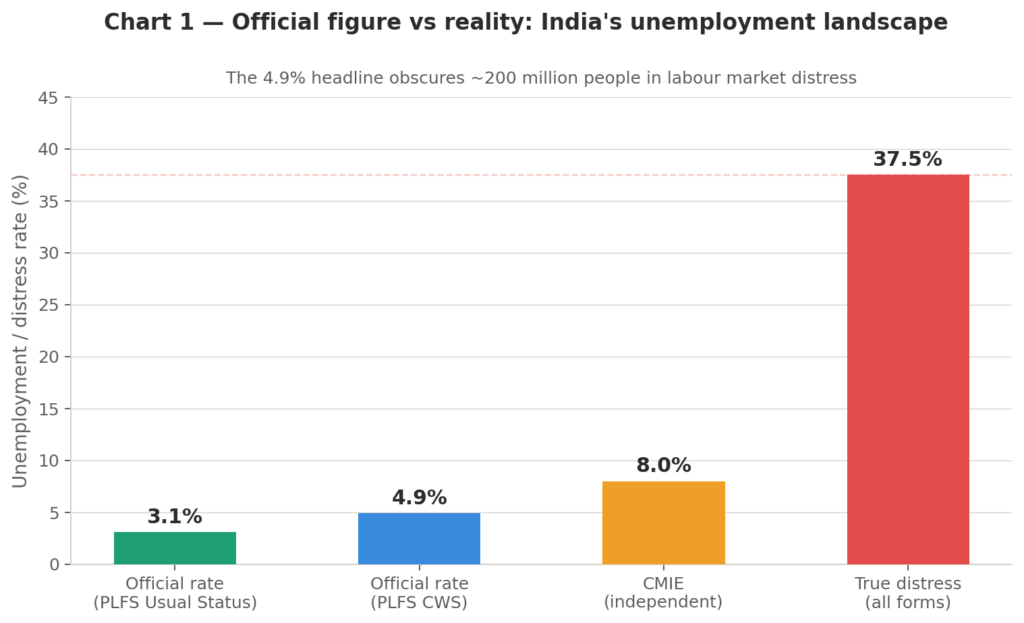
The Centre for Monitoring Indian Economy (CMIE), an independent private body that runs its own household survey of over 545,000 homes, consistently reports unemployment at 7–9% using the ILO definition — where only those currently earning an income are considered employed. CMIE’s methodology is stricter and arguably more aligned with economic reality.
But even 9% tells only part of the story. The true scale of India’s labour market distress becomes clear only when you account for four different types of joblessness, each of which demands a different policy response, and each of which is poorly captured by any single headline number.

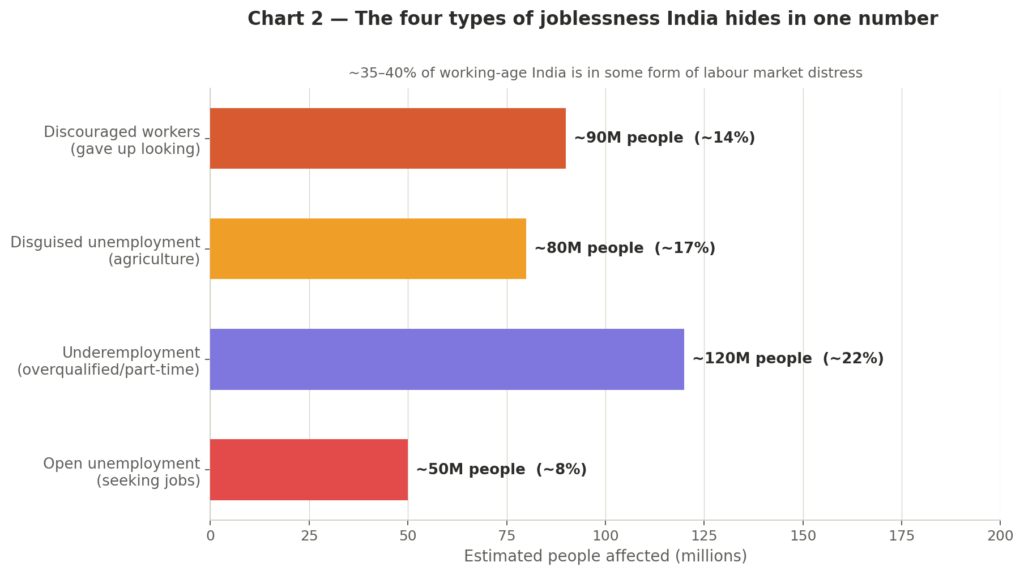
“If you count open unemployment, underemployment, disguised unemployment, and discouraged workers together, ~35–40% of India’s working-age population is in labour market distress.”
| Data Reliability Note The 4.9% PLFS figure is methodologically sound within its own definition. The 35–40% distress estimate is a synthesised figure and should be treated as directional. The graduate unemployment data from Azim Premji University is the most rigorously cross-validated number in this report |
2. Why the official number is a technical fiction — the PLFS methodology
Understanding the PLFS methodology is not an academic exercise. It is essential for anyone citing India’s unemployment data in a business, policy, or investment context — because the definitional choices embedded in the survey structurally produce lower numbers than economic reality warrants. The PLFS uses two methods. Usual Status (US) asks what a person’s primary activity was over the past 365 days. If you worked for as few as 30 days in the past year, you are classified as employed. A graduate who found one month of contract work and spent the remaining 11 months job-hunting does not appear in the unemployment count. Current Weekly Status (CWS) is stricter — it asks what you did in the past seven days — and produces the higher 4.9% figure.
Five structural distortions built into the methodology
- First: the 30-day threshold is the biggest single distortion. A construction worker who found 35 days of sporadic work across a year is “employed.” This is particularly significant in rural India where agricultural labour is intensely seasonal.
- Second: unpaid family helpers are counted as employed. If a family member assists in a household shop, farm, or business without receiving wages, they are classified as employed under PLFS. This materially inflates rural employment figures.
- Third: the domestic duties trap. Women who want paid work but are constrained by family circumstances are classified as engaged in “domestic duties” — a category that places them outside the labour force entirely. They do not appear as unemployed. They simply vanish from the statistics. This is the single largest source of undercounting in India’s unemployment data, and it affects approximately 80–100 million women.
- Fourth: the homeless and migrant exclusion. The survey is conducted at fixed household addresses. The most economically vulnerable workers — seasonal migrants, urban homeless, construction camp labourers — are structurally excluded from the sample.
- Fifth: seasonal interviewing bias. Agricultural India is deeply seasonal. Workers surveyed during peak harvest appear employed; the same workers surveyed during the lean season may appear unemployed. This creates significant volatility in monthly numbers that does not reflect underlying structural conditions.
| Parameter | PLFS (Official) | CMIE (Independent) |
| Sample size | ~270,000 households | ~545,000 households |
| Reporting frequency | Monthly (from 2025) | Weekly |
| Employment definition | 30 days work in a year | Currently earning income |
| Counts unpaid family labour | Yes | No |
| Typical unemployment output | 3–5% | 7–9% |
| Who runs it | Government (MoSPI) | Independent private body |
| The 2025 reform From January 2025, PLFS expanded its household sample from 102,400 to 270,472 — a near tripling of coverage — and shifted to monthly reporting. New variables covering household income, land ownership, and educational attainment were added. These are genuine improvements in timeliness and granularity, even if the underlying definitional issues remain unresolved. |
3. The graduate crisis — where unemployment hits hardest
If there is one dataset in this report that should be treated as both highly reliable and deeply alarming, it is the graduate unemployment data from the Azim Premji University State of Working India 2026 report. Unlike the headline unemployment rate, which suffers from definitional ambiguity, the graduate unemployment data is based on longitudinal tracking of specific cohorts and is cross-validated against PLFS microdata.
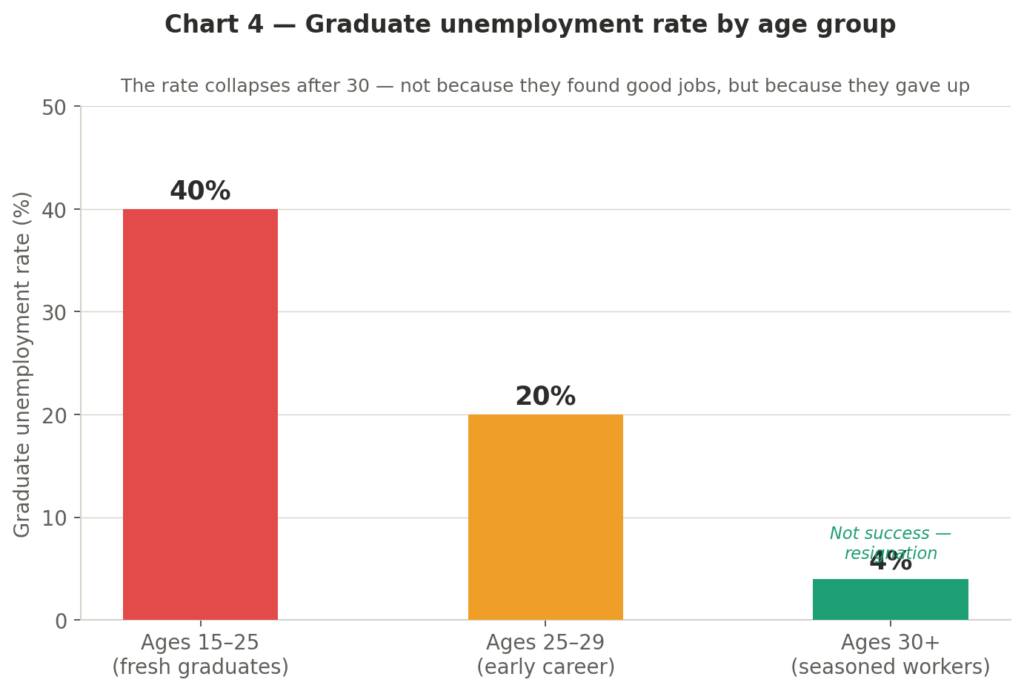
The finding is stark: 11 million out of 63 million graduates aged 20–29 are unemployed as of 2023. That is 17.5% of all graduates in that age bracket — but the breakdown by sub-cohort is even more alarming. Among those aged 15–25, the graduate unemployment rate is approximately 40%. Among those aged 25–29, it is approximately 20%. Only after age 30 does the rate fall below 4% — and critically, this is not because graduates find good jobs after 30. It is because they stop looking and accept whatever is available, however far below their qualification level.

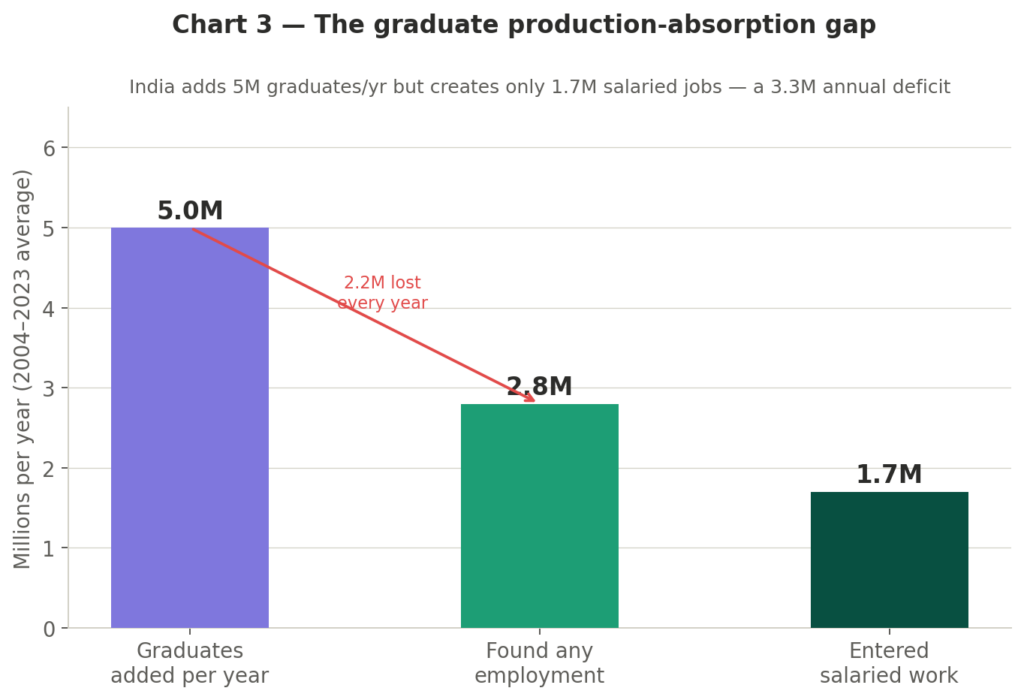

“Between 2004 and 2023, India added roughly 5 million graduates per year — but only 2.8 million found any employment, and only 1.7 million entered salaried work. The arithmetic of national waste is stark.” — State of Working India 2026, Azim Premji University
The 7% Club — the most damning statistic
Of all unemployed graduates who report themselves as jobless, only 7% manage to secure a permanent salaried job within one year. This is not a measurement of how many graduates eventually find work — it is a measurement of the velocity of the transition from education to stable employment. By that measure, India’s education-to-employment pipeline is running at approximately 7% efficiency.
The underlying cause is not a lack of jobs in absolute terms. It is a profound mismatch between what India’s education system produces and what its economy needs. The India Skills Report 2025 found that only 54.8% of Indian graduates are considered employable by industry standards. NASSCOM President Debjani Ghosh has publicly identified the systemic failure: “Our current educational system does not focus on building good communication skills, design thinking, out-of-box thinking, or problem solving.” IT companies report spending significant time and capital retraining freshers before they can be deployed on actual projects.
| Metric | Figure | Source |
| Unemployed graduates aged 20–29 | 11 million | Azim Premji 2026 |
| Total graduates aged 20–29 | 63 million | Azim Premji 2026 |
| Graduates unemployed (% of cohort, 15–25) | ~40% | Azim Premji 2026 |
| Graduates unemployed (% of cohort, 25–29) | ~20% | Azim Premji 2026 |
| Find permanent salaried job within 1 year | 7% | Azim Premji 2026 |
| Hold white-collar salaried roles (of all grads) | 3.7% | Azim Premji 2026 |
| Engineering grads who fail to find relevant jobs | 83% | India Skills Report 2025 |
| Considered employable by industry | 54.8% | India Skills Report 2025 |
| Share of unemployed youth who are graduates | 67% | Azim Premji 2026 |
4. What 30 million unemployed people are actually doing to survive
The question that rarely gets asked alongside the unemployment statistics is this: what are these people actually doing while they are “unemployed”? The answer reveals six distinct survival strategies — each rational given the circumstances, each with its own scale and implications for the economy.

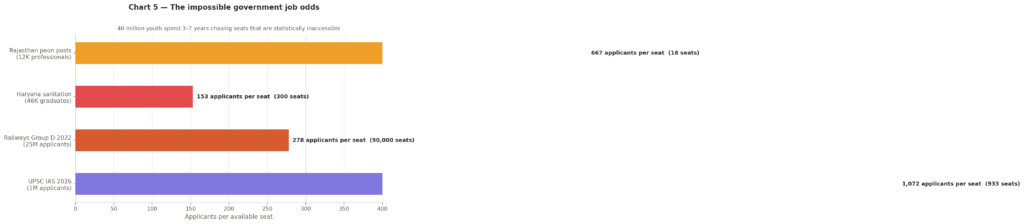
Strategy 1: Chasing the Sarkari dream (~40 million aspirants)
The single most dominant response to graduate unemployment in India is the pursuit of government employment — and the scale of this phenomenon is extraordinary. Approximately 40 million young people are actively preparing for central and state government examinations at any given time. The average preparation period is 3 to 7 years. Many spend these years in the coaching hub neighbourhoods of Mukherjee Nagar and Rajendra Nagar in Delhi, Katra and Baghada in Allahabad, or in purpose-built coaching cities like Kota in Rajasthan.
The odds are prohibitive. The UPSC Civil Services Examination 2026 has 933 available seats against approximately 1 million applicants. In 2022, 25 million youth applied for 90,000 Railways Group D positions. In 2024, over 46,000 graduates applied for sanitation jobs in Haryana — clearly overqualified — and 12,000 professionals competed for 18 peon posts in Rajasthan. These numbers reflect not desperation but rational calculation: a government job provides lifetime security, pension, social status, and protection from automation. Private sector jobs increasingly offer none of these things.

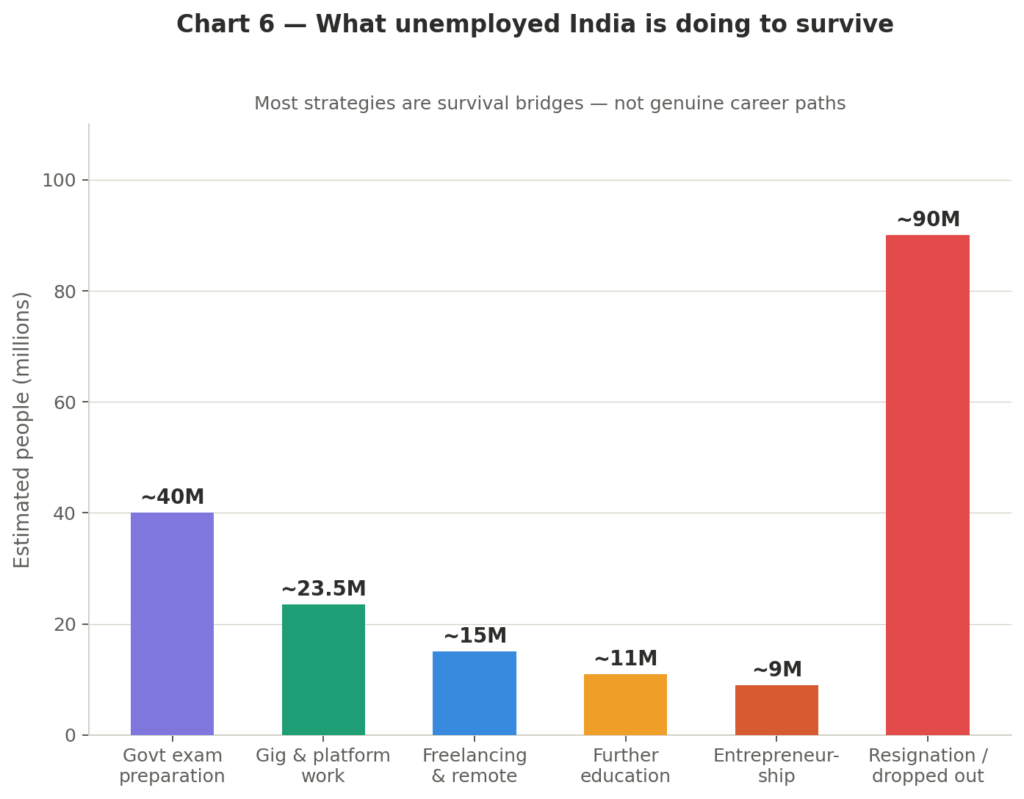
Strategy 2: The gig economy as survival bridge (~23.5 million)
India’s gig workforce has grown from 2.52 million in 2011-12 to an estimated 23.5 million by 2026, at a compound annual growth rate of approximately 17%. The Union Budget 2025 formally recognised gig workers for the first time, providing identity cards, e-Shram registration, and healthcare benefits under PM Jan Arogya Yojana. As of September 2025, over 312 million workers have registered on the e-Shram portal — a figure that captures the scale of India’s informal economy.
The key platforms — Zomato, Swiggy, Ola, Uber, Blinkit, and Porter for blue-collar gigs; Upwork, Fiverr, and Pepper Content for white-collar freelancing — collectively absorb millions. But most graduates view gig work as a temporary measure while they continue preparing for government examinations or waiting for corporate opportunities. It is a bridge, not a destination. Tier-2 and tier-3 cities are seeing 30–40% growth in gig hiring, suggesting the phenomenon is spreading beyond metros.
Strategy 3: Resignation and the invisible exit
The largest single cohort in India’s labour distress picture is also the least visible: the 80–100 million, predominantly women, who have exited the workforce entirely and do not appear in any unemployment statistic. They are classified as engaged in “domestic duties” — a category that conflates genuine preference with social compulsion. The feminisation of workforce dropout in India is a structural crisis that receives inadequate policy attention and zero representation in the headline unemployment rate.
Among men, the equivalent phenomenon is what researchers call the “resignation effect” — the dramatic collapse in graduate unemployment rates after age 30 that occurs not because men find appropriate employment but because they accept positions far below their educational qualification, from security guarding to data entry to casual labour. The aggregate experience of millions of individuals confronting the gap between educational aspiration and economic reality is the defining psychological experience of India’s working-age generation.
5. The psychological collapse — what unemployment is doing to India’s mind
India’s unemployment crisis has a shadow crisis that is even less visible in aggregate statistics and even more devastating in human terms: the mental health consequences of extended joblessness among a young, educated, aspirationally mobile population. The data from multiple peer-reviewed sources converges on the same alarming conclusion — unemployment in India is not merely an economic condition. It is a psychological emergency.

The clinical evidence
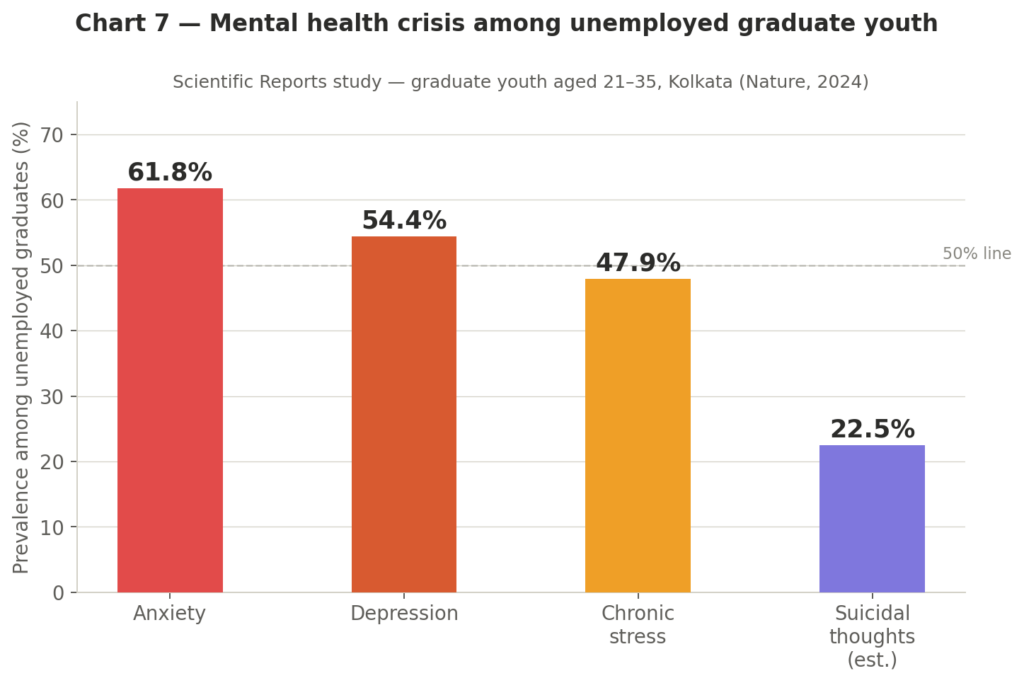
A peer-reviewed study published in Nature Scientific Reports (2024), focused on higher-educated migrant graduate youth aged 21–35 in Kolkata, found overall prevalence rates of 54.4% for depression, 61.8% for anxiety, and 47.9% for chronic stress among unemployed graduates — significantly higher than among their employed counterparts. The research notes that higher education leads paradoxically to higher unemployment risk, and that the resulting gap between expectation and reality is psychologically more damaging than unemployment among those with lower educational attainment.
A broader 2025 study published in the International Journal of Indian Psychology estimates that 20–25% of all Indian youth suffer from mental health issues including depression, anxiety, substance abuse, and suicidal thoughts. The National Mental Health Survey found that 10.6% of India’s total adult population — approximately 197 million people — lives with some form of mental disorder. Depression and anxiety alone affect more than 90 million people.

The suicide data
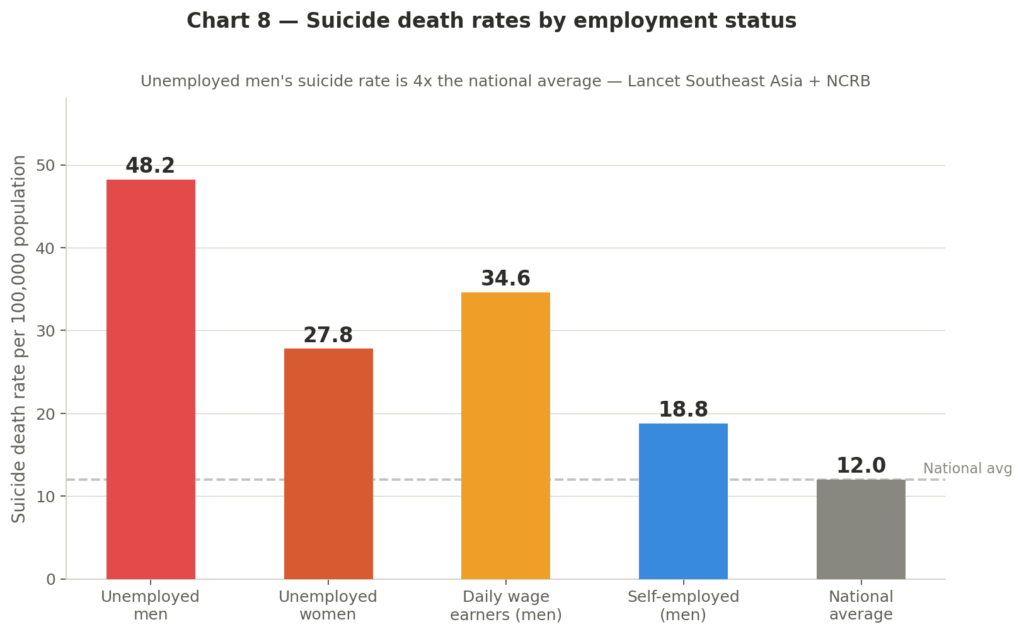
The most severe manifestation of this psychological crisis is captured in suicide mortality data. Research published in The Lancet Regional Health — Southeast Asia found that unemployed men have a suicide death rate (SDR) of 48.2 per 100,000 population, and unemployed women an SDR of 27.8 — both significantly elevated above the national average. Daily wage earner suicides increased 170.7% between 2014 and 2021.
The NCRB data for 2023 records 14,000 suicides among unemployed youth. The peak suicide risk age group in India is 15–29 years, at a rate of 38 per 100,000 — the same cohort most severely affected by graduate unemployment. India accounts for 36.6% of the world’s female suicides and carries nearly one-third of global depression, addiction, and suicide burden despite being a single nation.
The coaching hub city of Kota in Rajasthan — where lakhs of JEE and NEET aspirants live in cramped paying guest accommodations, separated from family, burning family savings, year after year — has become the most visible symbol of this crisis. Student suicides there make national headlines annually. The same pattern plays out in the UPSC preparation neighbourhoods of Delhi’s Mukherjee Nagar. These are concentrated pockets of highly educated, deeply isolated, financially pressured young people with no professional mental health support and enormous familial expectation placed upon them.
| The economic cost of ignoring this: India is projected to lose $1.03 trillion between 2012 and 2030 due to mental health conditions — making this not merely a humanitarian crisis but a macroeconomic catastrophe. A country cannot realise its demographic dividend when a quarter of its youth workforce is psychologically distressed and functionally paralysed. |
6. India’s response — what’s working and what’s catastrophically failing
India has not been passive in the face of this crisis. The government has introduced a meaningful set of programmes addressing both employment and mental health, and the private sector has responded with a wave of digital platforms filling gaps that public infrastructure cannot reach. But the honest assessment is that the scale of the response is fundamentally mismatched with the scale of the problem.

Government programmes that deserve credit
Tele-MANAS, India’s national tele-mental health helpline launched in 2022, has handled over 28 lakh calls across 36 states and union territories. It provides free 24×7 counselling through 53 cells nationwide, and has been recognised by the WHO as an innovative model for scalable mental healthcare delivery.
The District Mental Health Programme (DMHP) is now active in 767 of India’s districts, providing outpatient care, counselling, suicide prevention programmes, and 10-bed inpatient facilities at the district level. The Manodarpan initiative provides school-based psychosocial support covering 11 crore students. On the employment side, the Union Budget 2025 gave formal recognition and social security benefits to 23.5 million gig workers for the first time, and the e-Shram portal has registered over 312 million informal workers.
Where the system is failing
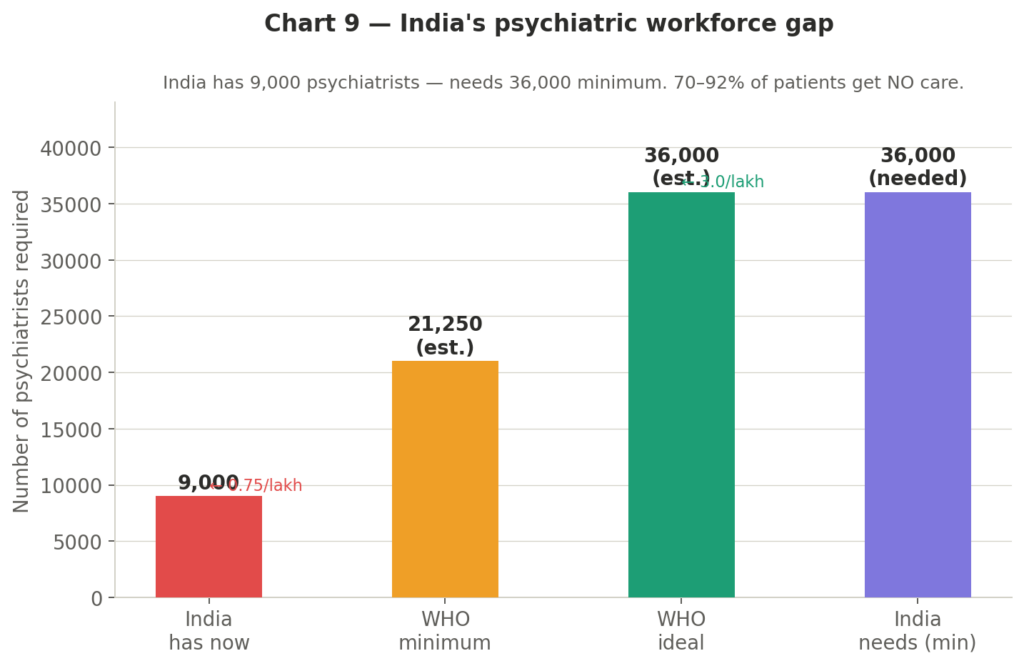
The psychiatric workforce gap is the most glaring structural failure. India has 9,000 practising psychiatrists against a minimum requirement of 36,000 — a 75% deficit. The psychiatrist density of 0.75 per 100,000 population is less than half the WHO minimum standard of 1.7, and one-quarter of the WHO ideal of 3.0. Beyond psychiatrists, India has only 4,309 clinical psychologists and 801 rehabilitation social workers — among the world’s largest per-capita shortfalls.
The consequence is a treatment gap of 70–92%: for every person receiving professional mental health care, between 3 and 9 people with the same clinical need are receiving nothing. The mental health budget allocation — at just 1.11% of the total health budget, or ₹1,004 crore in FY2025 — is a rounding error relative to the burden. Developed nations allocate 5–18% of health budgets to mental health.
The private digital sector — platforms like TalktoAngel, BetterLYF, iCall, HopeQure, Sukoon Health, and Manastha — is expanding rapidly to fill the void. Corporate Employee Assistance Programmes from providers like MindPeers and Silver Oak Health are reaching urban formal employees. But these solutions reach only the formally employed and the relatively affluent. The 40 million government exam aspirants sitting in PGs in Mukherjee Nagar, the 23 million gig workers without any employer, the rural youth returning to family farms — none of them are reached by any of these solutions.
| The AI phenomenon A significant and entirely unquantified proportion of India’s unemployed youth are turning to AI chatbots — including tools like Claude — for emotional processing and support. This reflects not a preference for AI over human connection but a rational response to cost (private therapy costs ₹1,500–3,000 per session), stigma (mental illness remains deeply stigmatised in Indian families), and access (government lines are overwhelmed). It is simultaneously a market signal and a warning about the inadequacy of existing human support systems. |
Conclusion — The complete picture in one narrative
“The demographic dividend is not a guarantee. It is a window. And India is burning through it.”
India stands at a genuinely historic inflection point. With 367 million people aged 15–29 — one-third of the working-age population — the country has the largest youth labour market in the world. The Azim Premji University report notes that this demographic window will begin to close after 2030. What happens to India’s labour market in the next four years will determine whether the demographic dividend is realised or squandered.
The current trajectory is concerning. India’s education system is producing 5 million graduates per year into an economy that can absorb only 1.7 million into salaried work — a structural deficit of 3.3 million new frustrated graduates every single year. Each cohort adds to a growing pool of educated, underemployed, psychologically stressed young people who rationally spend their most productive years chasing government jobs that statistically can accommodate less than 0.1% of aspirants.
The mental health consequences of this structural failure are catastrophic, and they are being absorbed almost entirely by individual families — without professional support, without institutional recognition, and without adequate government resources. The 9,000 psychiatrists serving 1.4 billion people represent a system designed to handle a crisis orders of magnitude smaller than the one it faces.
At the same time, India has genuine structural advantages that a well-designed policy response could leverage. The gig economy is the world’s second largest freelance market. The startup ecosystem is the world’s third largest by DPIIT-recognised entities. Digital infrastructure — smartphones, cheap data, Aadhaar-linked financial services — is now genuinely ubiquitous in a way it was not even five years ago. The ITI count has grown 300% since 2010.
The bottleneck in India’s labour market has never been talent supply. It has always been matching infrastructure, skill alignment, and the quality of the education-to-employment pipeline. Solving that bottleneck — through better employer-talent matching platforms, vocational training that genuinely tracks industry demand, and mental health infrastructure scaled to the actual burden — represents both a humanitarian imperative and the largest untapped market opportunity in Asia’s fastest-growing major economy.
| The one-sentence summary of this entire report India has 630 million people in its labour force, ~200 million of whom are in some form of distress — yet its official number says 4.9%; its 11 million unemployed graduates spend 3–7 years in coaching centres chasing 933 IAS seats; its gig economy absorbs millions as a survival bridge not a career; 80–100 million women have quietly exited the workforce and been erased from statistics; and those who break under the pressure face a mental health system with 9,000 psychiatrists for 1.4 billion people, a 70–92% treatment gap, and a government budget of just 1% — while 14,000 unemployed youth died by suicide in 2023 alone, and the country is projected to lose $1.03 trillion to mental illness by 2030. |
Sources & Data Reliability
| Source | Data Used | Reliability |
| PLFS 2025 — MoSPI / NSO | Official unemployment rates, workforce size | High (official) — definitionally narrow |
| CMIE Consumer Pyramids | Alternative unemployment rates | High — stricter ILO definition |
| State of Working India 2026 — Azim Premji Univ. | Graduate unemployment, salary data | Very High — cross-validated with PLFS |
| NCRB 2023 | Suicide data by occupation/employment | High — official government census |
| Scientific Reports / Nature (2024) | Mental health prevalence among unemployed graduates | High — peer-reviewed |
| Lancet Regional Health — SE Asia (2023) | Suicide death rates by employment status | Very High — peer-reviewed |
| WHO Mental Health Atlas 2020 | Psychiatrist density benchmarks | High — global standard |
| Parliamentary Standing Committee 2023 | India psychiatrist count (9,000) | High — official |
| India Skills Report 2025 | Graduate employability rates | Medium-High — industry survey |
| NITI Aayog / Union Budget 2025 | Gig workforce projections | Medium — government projections |
| Blue/white collar unemployment split | Estimated from sectoral data | Medium — synthesised estimate |